There’s a moment most Santas experience sooner or later. A child asks Santa a question that’s hard to answer. And in that moment, Santa does what all of us do when we care deeply about getting it right.
We say the first thing that comes to mind.
Sometimes it’s kind.
Sometimes it’s hopeful.
Sometimes it’s simply the best thing we can think of in the moment.
And then later that evening, or the next day, the moment returns.
We replay the conversation in our minds.
I should have said more.
I should have said less.
I wish I had answered that differently.
Many Santas quietly carry those moments for days.
Because when children trust us with their hard questions, we feel the weight of the role in a new way.
When Santa Isn’t Sure What to Say
Over time, Santas often begin asking one another the same question.
“What’s the right thing to say when a child asks…?”
And the questions vary:
“Santa, my grandma died.”
“Santa, my parents are getting divorced.”
“Santa, why didn’t I get what I asked for last year?”
“Santa, are you real?”
We trade answers.
We share stories.
We try to prepare.
But the truth is something many Santas eventually discover:
There is no single right sentence that works in every moment.
Children aren’t scripts.
Every child carries their own story, their own emotions, their own understanding of the world.
The moment belongs to that child, in that moment.
The Search for the Right Answer
What matters most often isn’t the exact words Santa chooses when kids ask the hard questions.
It’s the pause.
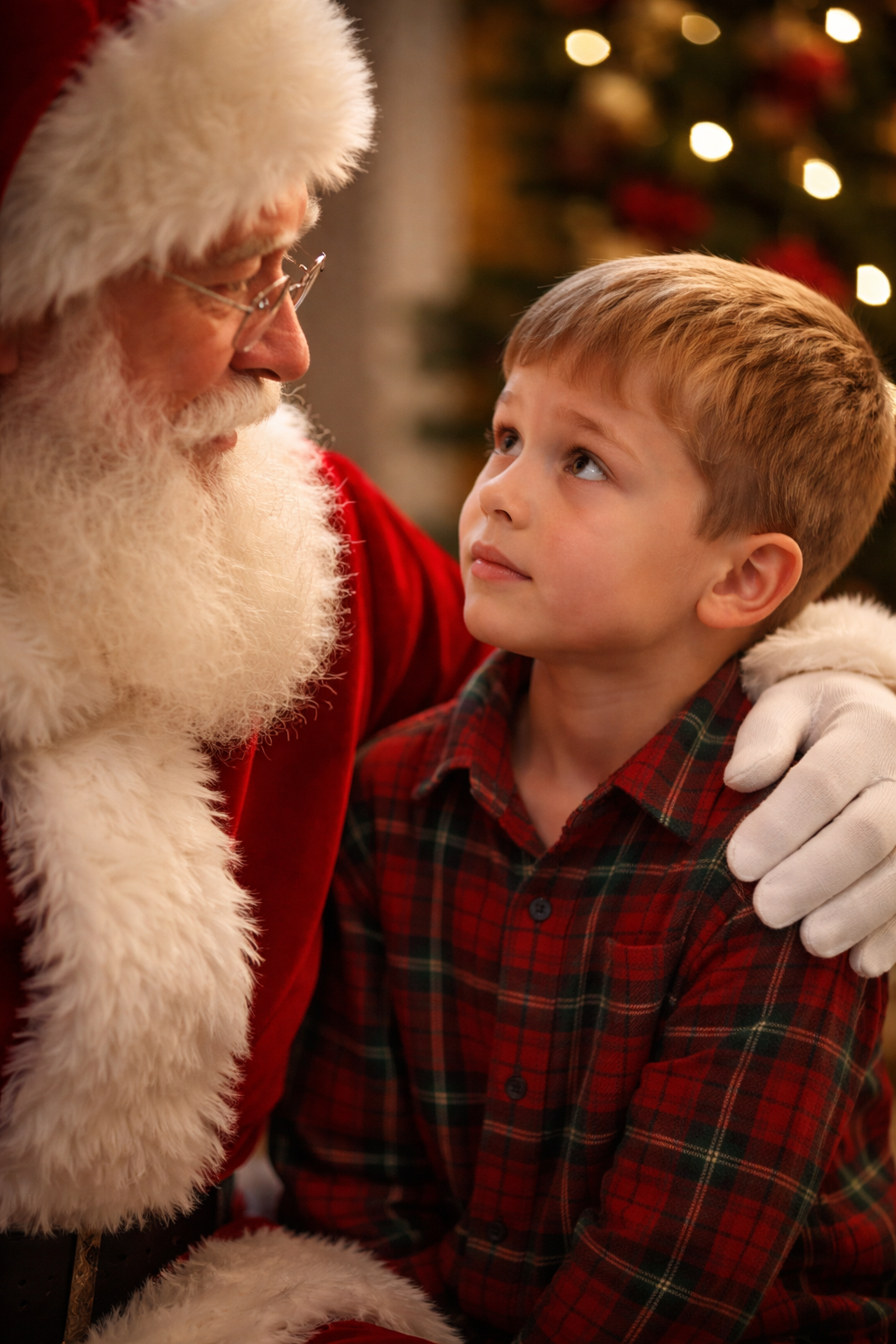
The moment when Santa slows down long enough to notice the child in front of him.
To read the expression in their eyes.
To hear the feeling beneath the question.
To recognize whether the child needs reassurance, honesty, or simply someone who will listen.
Sometimes the most powerful thing Santa can do is not rush to answer at all.
Just to be present.
Just to let the child feel that they have been heard.
What Children May Really Be Asking
When children bring Santa their hardest questions, they are often trying to understand a loss of connection.
Death.
Absence.
Divorce.
Illness.
Each one represents a change in the child’s world — a thread that once held their life together.
And in those moments, children sometimes turn to Santa with the quiet hope that the connection can somehow be restored.
Not always by solving the problem.
But by reminding them that kindness, care, and love still exist around them.
That the world is still safe enough to trust.
Sometimes Santa’s role in those moments isn’t to give the perfect answer.
It’s simply to help the child feel connected again — even for a moment.
Why Presence Matters More Than Perfect Words
Many Santas discover that the role slowly teaches them things no script ever could:
How to pause before answering.
How to recognize when a child is really asking,
“Do I matter?”
How kindness and gentleness can calm a moment faster than cleverness.
And how sometimes the right response is not a perfect explanation, but a quiet assurance that the child is safe, valued, and not alone.
A Different Kind of Conversation
The Santa Legacy Workshop grew out of these moments.
The ones we replay afterward.
The questions we wish we had answered better.
The quiet realization that being Santa is about far more than remembering what children want for Christmas.
It’s about learning how to show up when children trust us with their questions.
Because in the end, the most meaningful moments in the red suit aren’t the ones we rehearsed.
They’re the ones where we pause, listen, and respond with kindness in the moment we’re given.
The next Santa Legacy Workshop begins April 7.
If this kind of conversation resonates with you, you’re warmly invited to join us.
https://thesantalegacy.com/santa-legacy-workshop/
This is a conversation I care deeply about, and one I’ll be exploring further when I speak at the Santa Family Reunion in 2027.